Balloon with chain - Dogora: Ouvrons les yeux
Ioana Satmari • 4/28/2025The West and the “fallen world” are juxtaposed through a play of visual contrasts: black and white for education and civilization, color for the lyrical chaos of the streets. The dirty faces of children are set against the orderly expressions of adults, composing an image that, without stating it explicitly, legitimizes a hierarchy. Dogora: Ouvrons les yeux, directed by Patrice Leconte, becomes an illustration of how difference is digested, aestheticized, and ultimately tamed for the gaze observing from afar.
The film’s structure is shaped by repetition, which transforms observation into metaphor. Recurring motifs are efficiently grouped: traffic, garbage, children, monks, miners, rubber, the jeans factory, dancing, going to work, the bicycle, sleep, and tradition (clearly divided by gender). The musical montage reaches climaxes by intercutting exhaustion with exuberance, marking these fragments with a calculated crescendo, deliberately spectacular yet betraying an epic and touristic temptation, overly self-conscious.
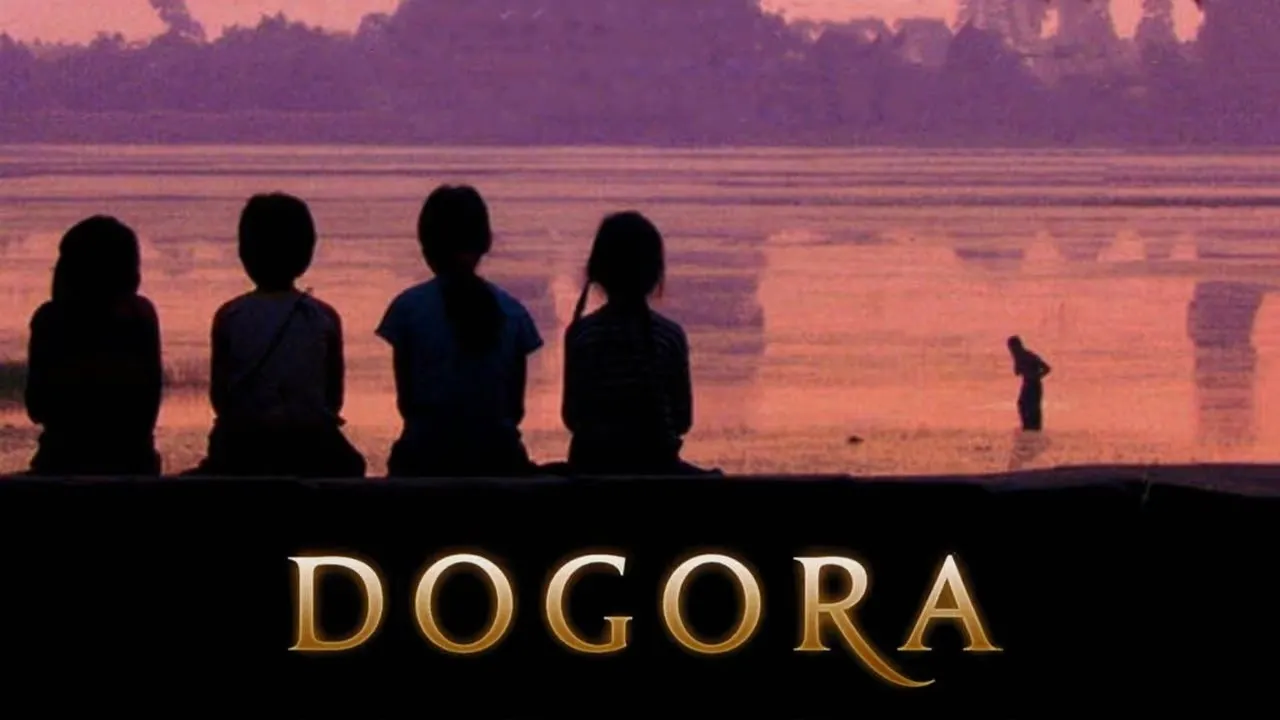
Dogora claims to open the eyes but, in reality, merely freezes the gaze into an aesthetic contemplation of otherness. From its very first frames, the film delineates the boundaries of a fabricated exoticism, where the chaos and rhythm of a distant world are tamed through a sequence of almost hypnotic images. A collection of images turns into a collection of collections, captured in light that shifts between golden and indigo hues.
A child crosses a strip of land bordered by water: a path that offers no choices, only a fixed direction, like a sentence. The director insists on this visual motif, and repetition turns it into a metaphor: here, the journey is not one of discovery but of predestination. The individual seems absorbed into the landscape, and the viewer, in turn, is invited to contemplate this forced path. Otherness is thus consumed in a spectacle of a life already written.
The Western gaze finds art in misery, seeks to extract satire from poverty, sees in dust an opportunity for a nostalgic golden-hour frame, and gets lost in what it identifies as picturesque: garbage becomes décor, the fatigue of workers a study in texture, and improvised dancing in the dust (a revelry reminiscent of Cinderella’s fairy-tale balls). Beauty is extracted from precarity, yet with a subtle air of superiority, where the aestheticization of poverty takes on the tone of a National Geographic documentary on “how survival works.” When chaos is combined with crowds and a patchwork understanding of culture, it yields Art at the level of Beauty, a Beauty of the unattainable. The film attempts to “capture” the unknown, wild, untamed beauty. This Western gaze finds its ecstasy in the epic temptations of the unknown, wild, untamed beauty.
The film slips into cliché when it overlays the West onto the “fallen world,” closing the circle with a chromatic contrast: black and white for education and civilization, color for chaos and (im)pure joy. The dirty faces of children are placed opposite the orderly faces of adults, in a frame that seems to implicitly justify the superiority of one system over another. In the end, Dogora becomes a mirror of otherness and a visual exercise in how the Western gaze transforms cultural difference into a visual spectacle: one dominated by the temptation to romanticize poverty.