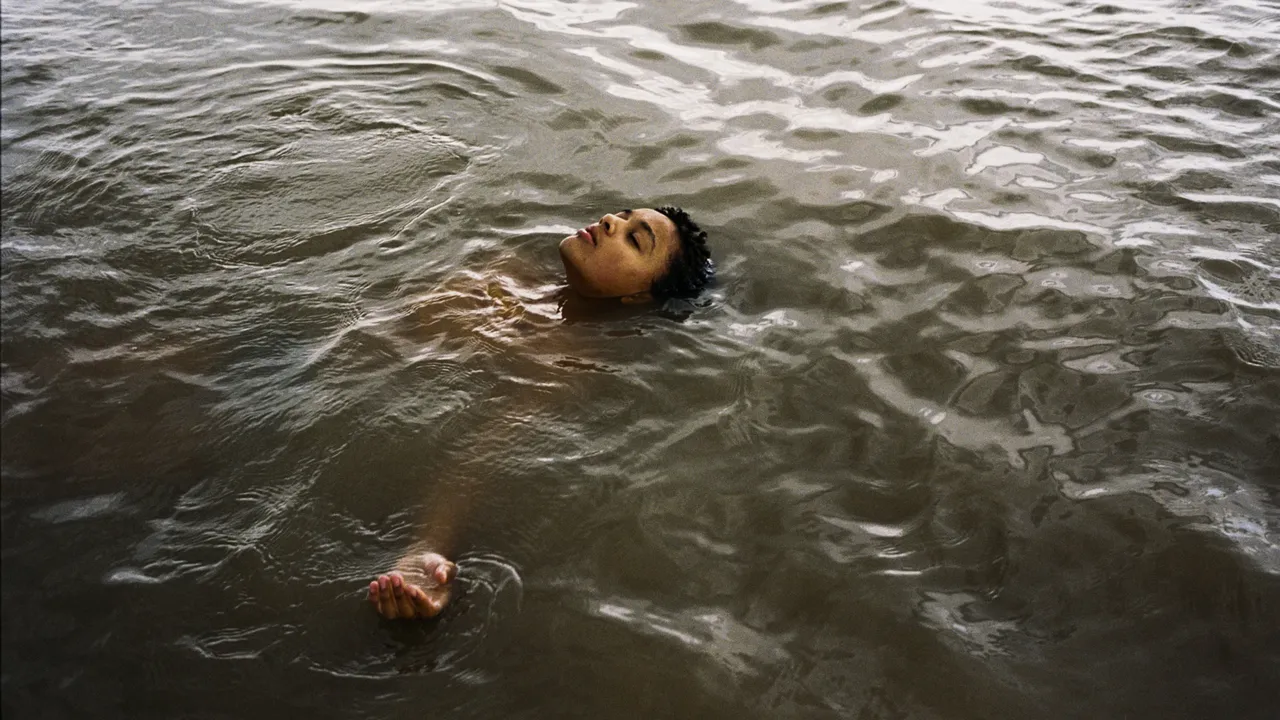
The blue falls from the sky into the living room - Bird
Ioana Satmari • 4/11/2025Although you watch the story from a city at the edge of the world unfold, the intimacy with which the characters move gives you the feeling that you’ve stepped into someone’s home, where the rooms seem endless. From the blue of the sky to the blue of the water, the film weaves together the shades of a world like an infinite living room, an Aquarium with glass walls where the characters float and struggle.
Bird, the feature film directed by Andrea Arnold, paints the aquarium walls in a blue of longing. A secret blue, like tender naivety. A poisoned blue, like a hidden depth. But the blue falls into nostalgia, caught in the nets of a fractured childhood.
With an absent and drug-dealing father (Barry Keoghan), Bailey (Nykiya Adams) runs from one end of the city to the other, trying to take everyone “under her wing”. She wanders as far from home as possible, surrounded by creatures tinged with blue. The seagull that opens the film, with its blue faded into gray on outstretched wings. The speckled sparrow with a blue glint in its eye, the frog covered in an oily blue sheen, the butterfly with hypnotic blue spots. A dead bee on the windowsill, its wings catching small blue waves in the light. A horse seen from below, silhouetted against the clear sky. In the fight for survival, power and influence come from appearance, and the thoughts and feelings of the “small,” of children, dissolve into the gray city.
The film is composed of moments reminiscent of Andrea Arnold’s previous works, a collage of fragments that seem torn from a life caught between brutal realism and an uncertain fantasy. Though Bailey senses every turn in the spiral she cannot break, she knows how deeply the toxicity of the world around her seeps into her life. But the spiral tightens again, because the order of the world cannot be disturbed. A sweet, bitter hope, like American Honey bourbon, the longing to escape, to break free. But the mix of comfort and poison makes you stay. As the narrative drifts toward the fantastic, everything that once seemed real unravels.
As if you were in your own living room, things breathe. As if the clattering echo of your footsteps in the iron tunnel had rotted somewhere in your mind. As if the back alleys and disorder were things you had crumpled up into forgetfulness. Suddenly, you no longer trust what you’ve seen, nostalgia dissolves, and in its place remains a sense of unease. You have felt the world’s harshness in a way that Bailey, at just 12 years old, cannot yet see. You have sensed the false closeness of adults, the illusory protection they offer one another. All this precisely because you watch as an adult, from the outside, knowing all too well that things do not change.
In this world, blue is not for hope or clear skies. Blue does not mean a seaside holiday. Here, you are surrounded by a blue like spilled Milk, trampled underfoot by all those who should not be shaping your future.
Watching Bird, you are the one above, the one rough, the one coarse. Watching Bird, you are not the bird soaring, but the Wasp that stings, yet nothing changes. You are the one who sees things as Transparent and chooses to see them as opaque. In a blend of harsh realism and fragile lyricism, the fantastic brings a trace of magic, but one that does not soothe. On the contrary, it overturns credibility, making every image take on a deceptive contour. And yet, watching the film, you find yourself caught in this world, with nostalgia and familiarity. As if you were in your own living room, with the echo of your footsteps resounding somewhere, forgotten, in your mind.